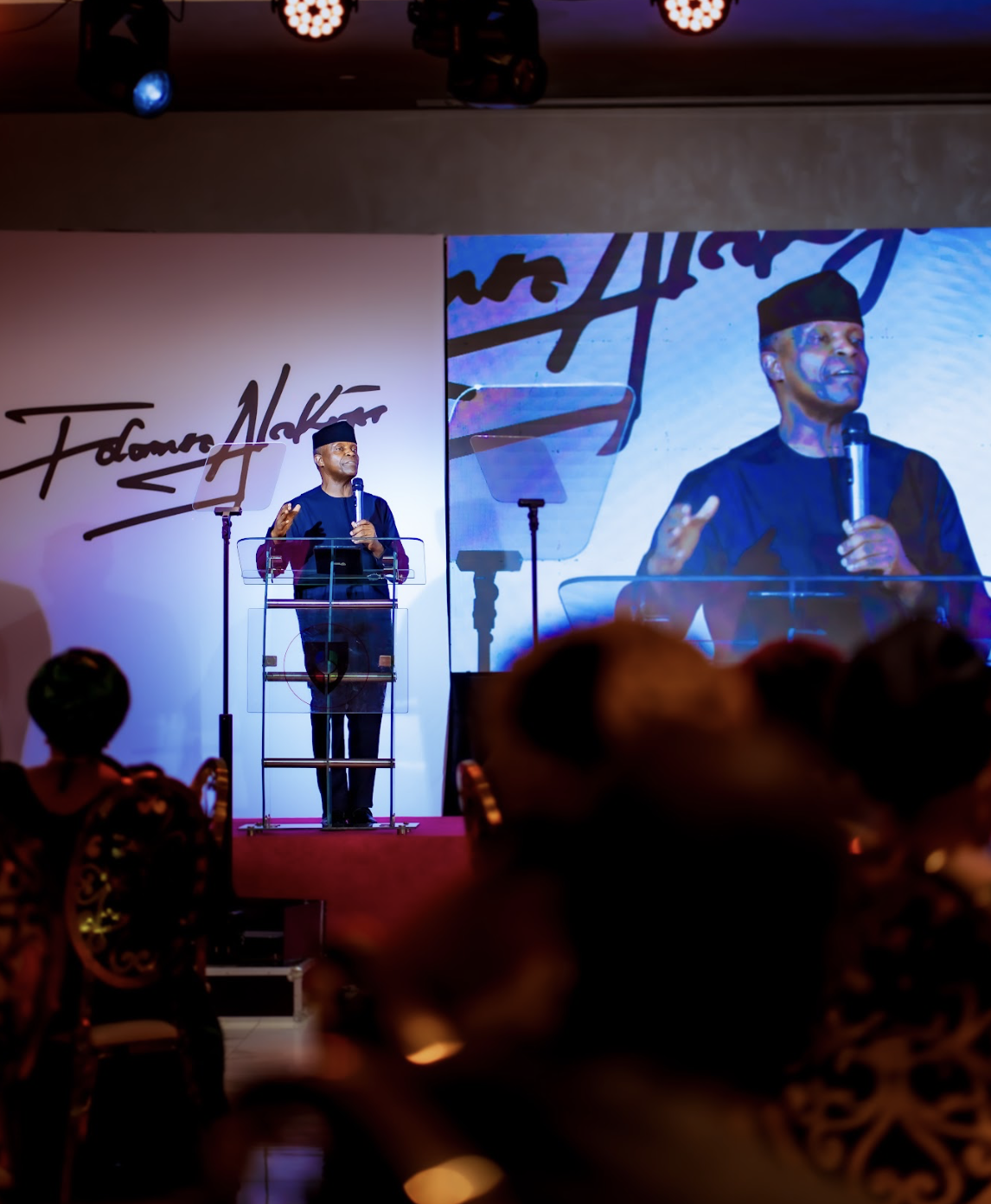
Vice President of Nigeria, H.E. Yem Osinbajo Transcript for Keynote Address at Harvard University Center For African Studies Alakija Religion and Public Life Gala Night

Publication information:
Abstract
In 2025, the Alakija Distinguished Lecture on Religion and Public Life Gala Dinner gathered leaders with the purpose of supporting the Study of Africa at Harvard through partnership and philanthropy. The centerpiece of the evening was a keynote address by the former Vice President of Nigeria, His Excellency Professor Yemi Osinbajo, who spoke on the critical importance of research in Africa—spanning public health, agriculture and food security, the green economy, and national security. The Center for African Studies invited attendees to reflect on the most important questions facing Nigeria and Africa in the next 25 years and to consider how Harvard and Nigeria can work in partnership to catalyze the region’s full potential.
OSINBAJO: The collaboration with the Africa Centre is an important one, especially in the area of Africa focused research, at such a decisive time in African development, the point is that funding for such research must now come from African philanthropy, governments and the private sector. That is the only way to signal the importance of many of these uniquely African issues and prioritize them. Which really is what I have been asked to speak to this evening: The Role of Philanthropy and Public Leadership in Advancing Africa-Focused Research and Impact. The Role of Philanthropy and Public Leadership in Advancing Africa-Focused Research and Impact. Perhaps I should begin with a provocative statement, that Toyosi quoted with a slight modification: that Africa will impact the world – for good or ill – over the next two decades. This continent will shape the world for good or ill in many important ways in the next two decades. The stakes are high. If we stumble on a few critical fronts, the consequences will be catastrophic well beyond our borders; if we succeed, the upside for Africa and the world will beextraordinary. Four levers will determine the outcome: 1. Our population and human capital; 2. Our climate trajectory; 3. Our productive capacity in agriculture, manufacturing, and technology; and 4. Our ability to maintain security and stability. Consider population and human capital. By 2050, Africa’s population will be well above two billion, with Nigeria among the top four most populous nations in the world...we should be thinking of a new social compact for Philanthropy-Public Partnerships: A Compact to fully leverage research for Africa’s transformation. The collaboration between philanthropy and public leadership is key. This will involve co-funding and matching grants. Governments can set up challenge funds where philanthropic funds are matched by public investment. We can have also have Joint Agenda Setting. Philanthropy and governments can co-develop research agendas possibly aligned with Agenda 2063 and the SDGs. We should support all Africa focused Research Platforms. Pan-African consortia, such as the African Research Universities Alliance (ARUA), should be supported as regional public goods. Africa stands at a crossroads. One path leads to climate stress, food insecurity, and social fracture. The other leads to human capital unleashed, green industry built at scale, healthier lives, and shared prosperity. The difference between the two is knowledge – and the will to fund it. Let African public leadership and African philanthropy meet at the crossroads of research. Let them build the labs, the datasets, the institutions, and the people who will shape our future. If we choose that partnership with seriousness and scale, Africa will not merely avoid catastrophe; it will lead the world into a more innovative, more sustainable, and a more just century.
Full text
The Role of Philanthropy and Public Leadership in Advancing Africa-Focused Research and Impact (attached below)