Student Lens: Reflections from Sierra Leone’s Presidential Visit to Harvard and CAS
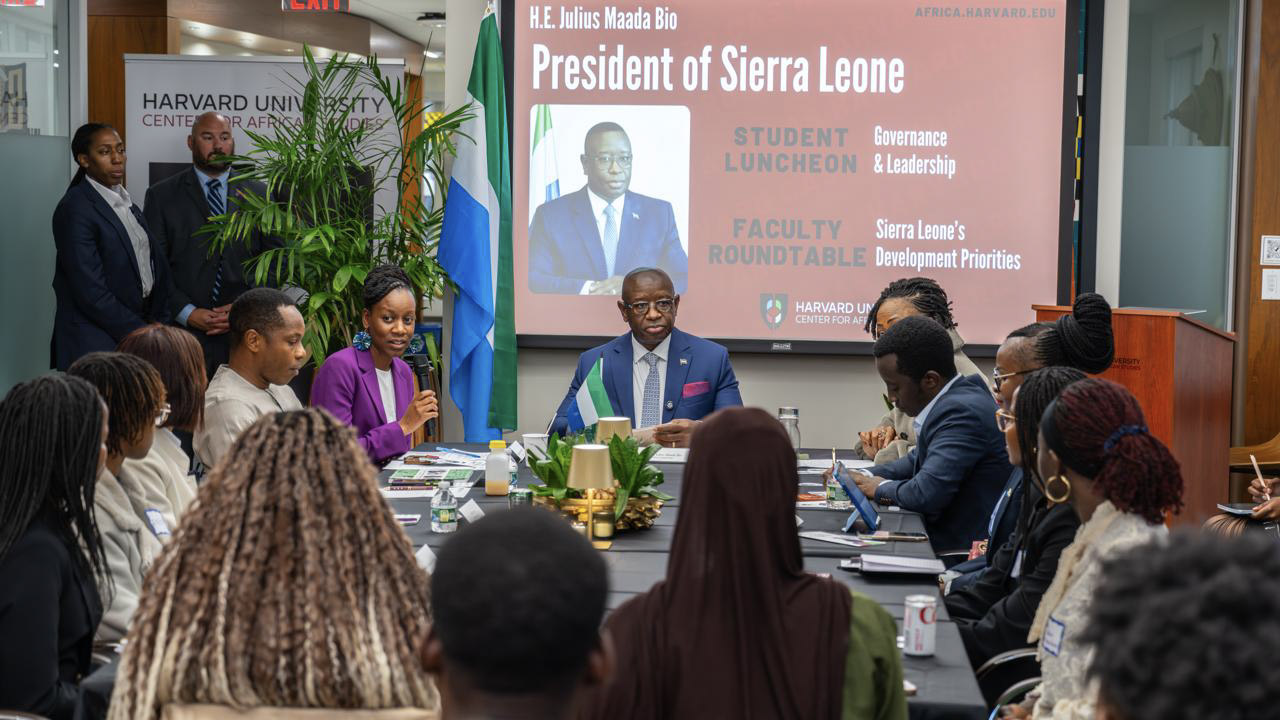
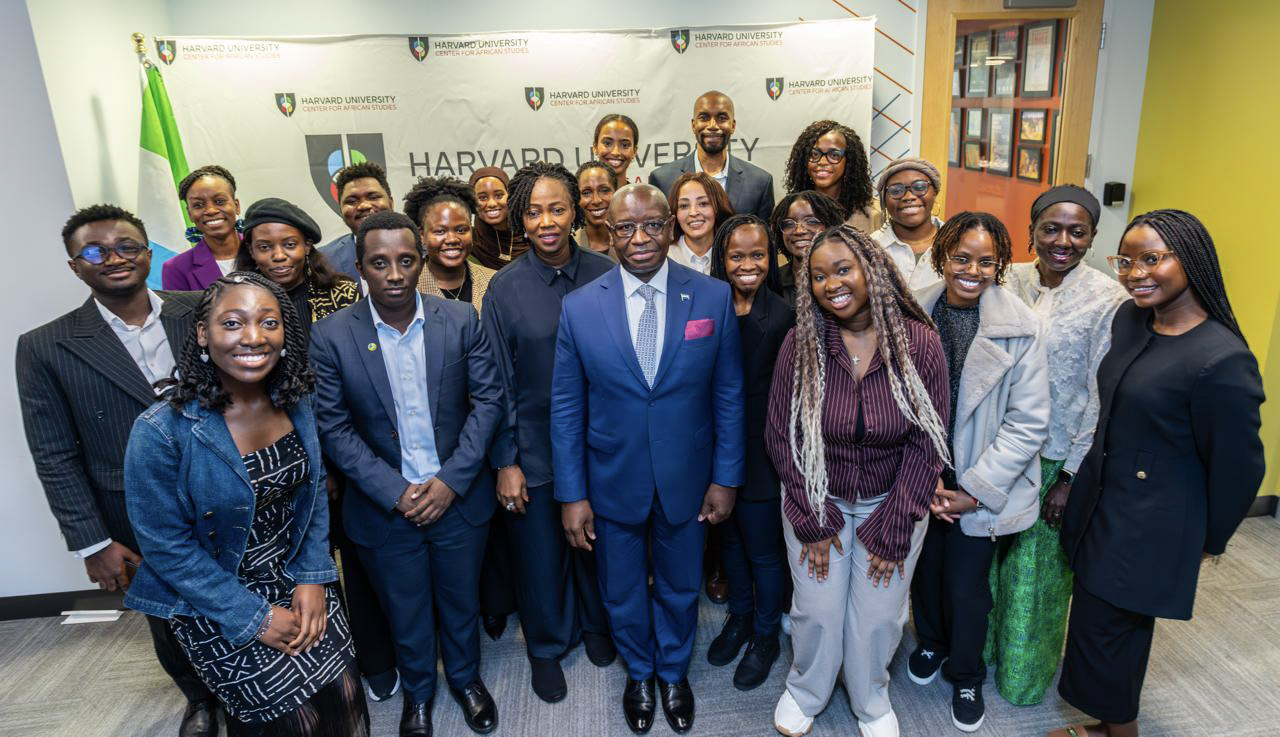
The leaders of the 19 Africa Student Organizations were invited to a presidential luncheon, as part of the Presidential Visit of Sierra Leone
By Wantoe Teah Wantoe
Harvard Graduate School of Education | Master’s Candidate, Education Policy & Analysis
Last week, I had the privilege of helping co-organize H.E. Julius Maada Bio’s, President of Sierra Leone, visit to Harvard; specifically, a student dialogue at the Harvard Center for African Studies. We did not want to simply organize another presidential visit where a distinguished leader delivered remarks, students listened, photographs were taken, and everyone returned to their respective schools. I wanted us to use the presence of a sitting African head of state to do something more intentional: bring student leaders from across Harvard’s 19 Africa-focused student organizations into direct conversation with the president.
Across Harvard, there is a remarkable concentration of Africans preparing for lives of leadership. Students are studying education and public policy, business and law, public health, development, technology, economics, and government. We come from countries across the continent, and our journeys after Harvard will take us in different directions. Some will return immediately to the continent. Others will work across international institutions, academia, business, governments, companies, and universities across the world. We all sat together around a table, envisioning, and I wanted to share five “nuggets” of information I took with me.
Five Ideas That Stayed with Me
Universities should not only be places where Africa is studied. They should be places where Africa is heard, engaged, and connected. I imagine a deeper relationship: African ministers engaging researchers studying the problems their ministries confront; African university leaders building sustained partnerships with global academic institutions; students contributing to policy conversations rather than simply studying their outcomes years later; researchers spending more time listening to practitioners; and policymakers being willing to encounter evidence that challenges their assumptions.
What happens after a government declares something a national priority? That is where the difficult work begins. Universities can generate knowledge about what evidence suggests should work. Governments must determine how ideas survive in contact with political, economic and institutional reality. We need more spaces where those two worlds meet.
The future was also sitting around the table: President Bio was naturally the most prominent person in the room. But he was not the only leader in it. Africa’s future leaders are not waiting somewhere in the distant future. Many are already in our classrooms, universities, communities, and institutions, developing the ideas and relationships that will shape what comes next. Growing up in Liberia taught me never to underestimate where a young person’s journey might lead. When young people are given meaningful access, they should leave with more than a photograph; they should leave with a stronger sense of purpose.
Respect and intellectual rigor are not contradictory. The dialogue also reinforced something I believe strongly about engaging political leadership: respecting the office of a president does not mean avoiding difficult questions. Serious engagement demands them. As African students, we should be capable of engaging our leaders critically and constructively: recognizing progress where evidence supports it, questioning shortcomings, examining assumptions and asking why implementation sometimes falls short of ambition. We did not want ceremony, but neither did we want confrontation for its own sake. I wanted the conversation to be respectful, intellectually rigorous, and honest. But I was equally interested in questions that policy documents cannot answer. What experiences shape a president? How does leadership change when the decisions you make affect millions of people? What happens when implementation does not match ambition? How do political realities alter decisions that may appear straightforward in an academic setting? How should African leaders respond to a generation of young people increasingly impatient for change? And what responsibility does one generation of African leaders have to prepare the next?
Access should create more access. Leadership should widen the room. That experience gradually gave me a philosophy that continues to guide how I approach leadership.: I have carried that philosophy with me to Harvard. As a student at the Harvard Graduate School of Education and a Student Ambassador with the Harvard Center for International Development, I have become increasingly interested in what it means for Africans studying at globally influential universities to use these institutions not simply for our individual advancement, but as platforms for connection. For me, the significance of entering important rooms is not that we can say we were there. Leadership begins when we ask what we can do with the access we have been given, whose voices we can bring with us, and whether the doors remain wider after we leave.
The Vision for the Conversation
The composition of the room was intentional. We wanted African student leaders from across the University. Our goal was not to create a conversation belonging to one Harvard school, one discipline, or even one country. That mattered because Africa’s challenges do not exist within academic departments. Education cannot be separated from economics. Public health cannot be separated from governance. Technology is transforming nearly every dimension of development. Climate change intersects with agriculture, migration, public finance, and national security. Youth unemployment is simultaneously an education challenge, an economic challenge, a political challenge, and, increasingly, a question of social stability.
A student studying education may interrogate human-capital development differently from an economist. Someone interested in entrepreneurship may understand youth unemployment differently from someone studying government. A public-health student may think about state capacity differently from a political scientist.
For me, this vision was also deeply personal. I grew up in Liberia, a country whose recent history has been shaped by enormous challenges and by people who repeatedly imagined something before them. My own journey has taken me into rooms I could hardly have imagined. At the University of Oxford, I had the privilege of serving as President for Postgraduates of the Oxford University Students’ Union, representing thousands of graduate students and participating in some of the University’s highest levels of governance. I learned that leadership is about who you carry with you. I am grateful to the Harvard Center for African Studies, particularly Chidi Blyden, the Center’s Executive Director, and Professor Zoe Marks, the Faculty Director. The President’s team, student leaders, and the full CAS staff recognized that students are not simply participants to be invited into the room, but rather partners who could contribute to designing the conversation itself. This partnership reflected something important about how universities can approach engagement with Africa: combining institutional leadership and academic expertise with the perspectives, networks and lived experiences of African students at the university level.