

CAS convenes a Faculty Research Roundtable with Harvard Professors and Key Ministers of Sierra Leone
Sierra Leone Ministers and Harvard Faculty discussed the priorities of Sierra Leone, including strengthening health systems, investing in education & human capital, and economic development.
Cambridge, Mass. — On October 29, the Harvard University Center for African Studies welcomed His Excellency Julius Maada Bio, President of the Republic of Sierra Leone, for a Harvard visit that included a welcome motorcade and flag ceremony with the Sierra Leonean delegation, a student luncheon focused on governance and ethical leadership, a faculty research roundtable on Sierra Leone’s development priorities, and an evening at the JFK Forum.
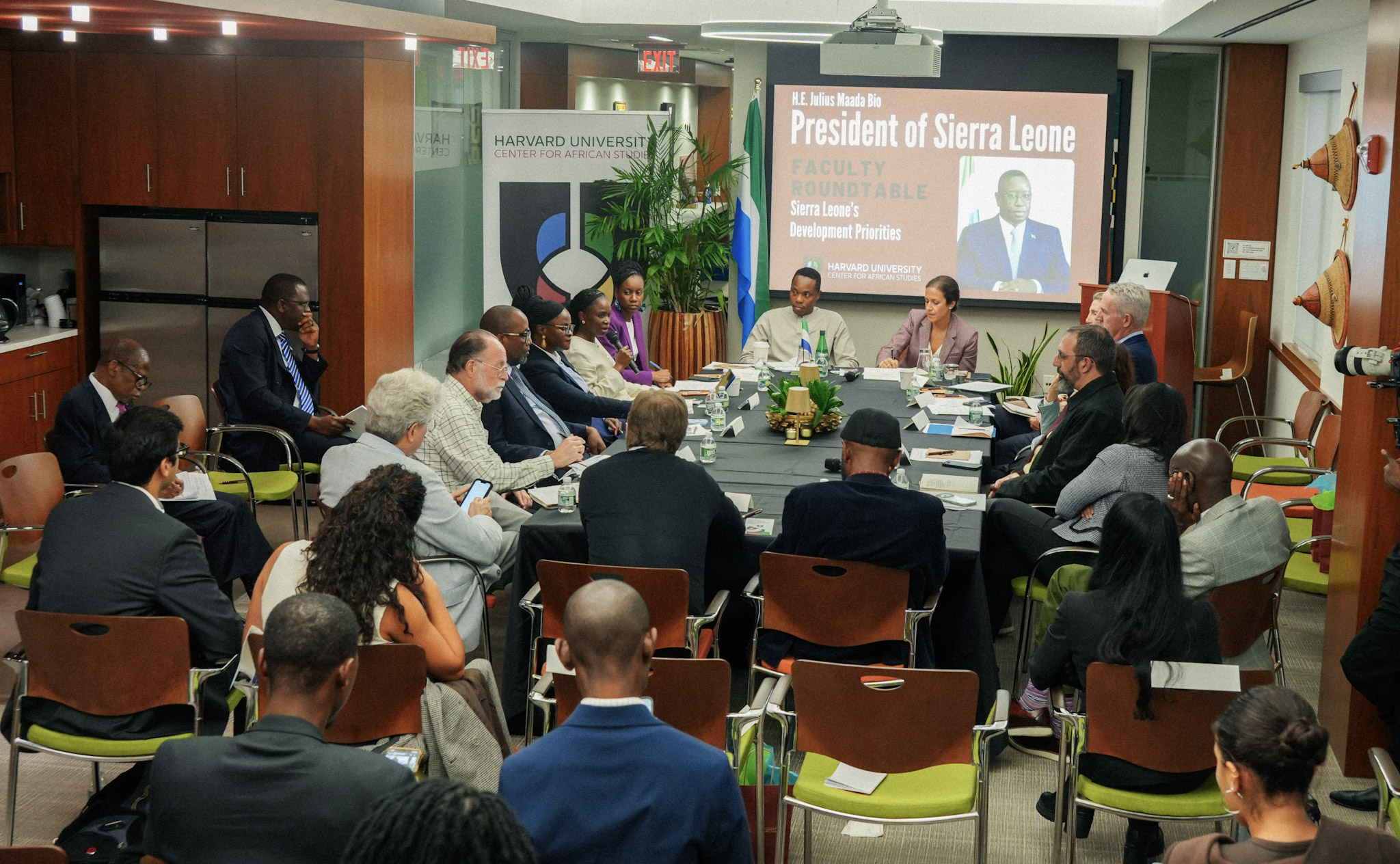
The faculty roundtable brought President Bio together with members of his cabinet, key ministers, government diplomats, and Harvard faculty whose work addresses Sierra Leone directly or speaks to the country’s challenges in public health, education, economic development, artificial intelligence, governance, technology, and foreign policy. The roundtable was moderated by Dr. Zoe Marks, Oppenheimer Faculty Director of Harvard’s Center for African Studies and a Lecturer in Public Policy at Harvard Kennedy School. Marks is a scholar of African politics whose current research draws on nearly a decade of fieldwork in Sierra Leone.
Sierra Leone’s Development Priorities
President Bio opened the roundtable by describing the growing uncertainty facing African governments as artificial intelligence begins to reshape public institutions, decision-making and governance. “With the advent of AI, we are even more confused,” Bio said. “We don’t know the extent to which AI is going to impact even governance.” He argued that African leaders must move quickly to understand the consequences of technological change, particularly because no country or institution has a monopoly on information and knowledge. “When we can understand the complexity and engage the research community, to generate new knowledge—and how we can use that knowledge to inform our decisions.”
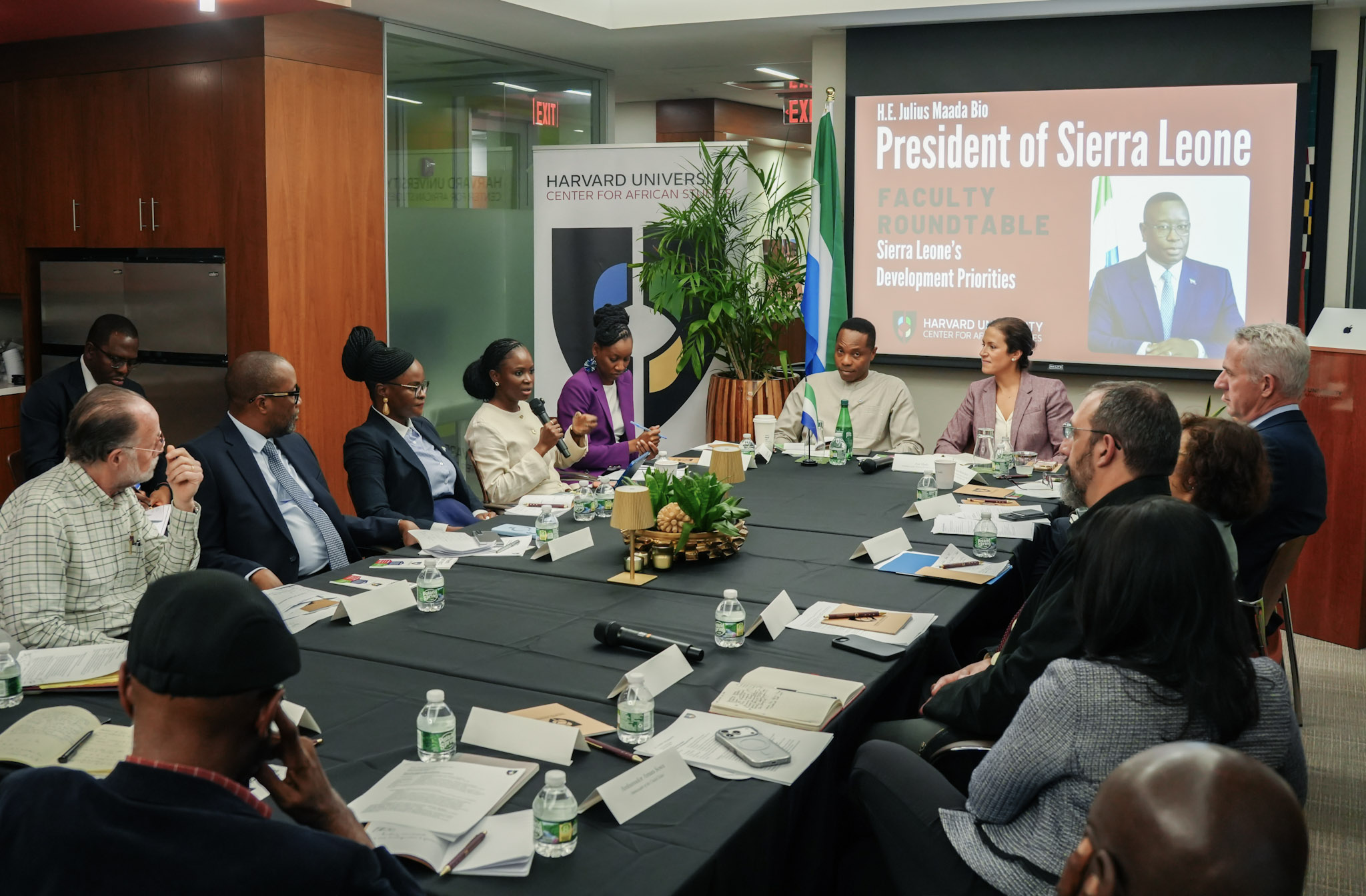
As the faculty presentations began, Marks and faculty highlighted impactful components of their research, while also identifying possible areas for future research, partnerships, and capacity strengthening. Marks said she would occasionally help connect individual presentations to the broader work of Harvard’s labs and centers, but that the faculty members would speak for themselves and for the research communities they represented. She also told the delegation that Harvard’s support would not be limited to projects in which the faculty members at the table directly participated. “If they aren’t personally setting out on collaborative research with the government, they might be able to steer other scholars, rising doctoral candidates, to work on issues that are of priority to you,” she said to the ministers present.
President Bio was accompanied by Sierra Leone’s Chief Minister, Dr. Moinina David Sengeh, who led the discussion on behalf of the Government of Sierra Leone after the president’s opening remarks. Sengeh is a graduate of Harvard College, serves on the Leadership Council of Harvard’s Center for African Studies, and oversees the president’s agenda and portfolio policy and implementation. Other members of the delegation included:
- Salima Monorma Bah, Minister of Communications, Technology and Innovation;
- Dr. Haja Ramatulai Wurie, Minister of Technical and Higher Education;
- Musa Timothy Kabba, Minister of Foreign Affairs and International Cooperation; and
- Sierra Leonean diplomatic representatives serving at the United Nations and in Washington, D.C.
Strengthening Health Systems
Faculty remarks began with Professor Vanessa Kerry, a faculty member at the Harvard T.H. Chan School of Public Health and the founder and chief executive officer of Seed Global Health. Kerry spoke about Seed’s work with Sierra Leone’s Ministry of Health and Sanitation and focused on the country’s efforts to improve maternal and child health. She was encouraged by the Ministry of Health’s leadership in placing maternal and child health at the center of the government’s national and international agenda. She mentioned that the investment in education, clinical training and health-system infrastructure had contributed to a 60 percent reduction in maternal mortality in select districts. She explained that A stronger workforce can help a country respond not only to maternal mortality, but also to pandemics and climate-related health threats. She proposed further research on how investments in health could be measured not only as social spending, but also as a source of employment and economic growth.
Professor Alos Moff, a professor at Harvard Medical School and a researcher at the Broad Institute, discussed his partnerships with Sierra Leone and other West African countries, which were built over nearly a decade and based on the idea that disease outbreaks should be detected and addressed by scientists, health workers and communities closest to the outbreak. His team worked with the Ministry of Health and Sierra Leonean laboratories to expand testing capacity and conduct genomic sequencing. The resulting analysis identified the viral lineage driving the outbreak and helped inform the public-health response. He also highlighted “Lookout,” a data platform co-created with Sierra Leone’s National Public Health Agency for genomic surveillance. The platform continues to support decision-making at the Ministry of Health and the national level. Moff said the experience demonstrated that international research partnerships are most effective when Sierra Leonean institutions, scientists and leaders direct the work and when government support is sustained over time.
Investing in Education & Human Capital
Professor Robert Jenkins, a faculty member at the Harvard Graduate School of Education, focused on the relationship between school access, learning and workforce preparation. Jenkins said Sierra Leone had made significant progress in reducing barriers to school attendance, including for children from marginalized communities. Jenkins said Sierra Leone could offer useful examples to other countries struggling with the same problem.
Professor John Mugane, the founding director of Harvard’s African Language Program and a professor in the Department of African and African American Studies, said language remains one of the most overlooked issues in African development and knowledge production. He described language as “the biggest elephant in the room,” particularly in countries and regions with many languages but limited resources for developing those languages in print, education, courts and digital systems.
Professor Eliana La Ferrara, a professor at Harvard Kennedy School and a development economist whose research examines the role of social norms and culture in economic development, discussed how the government can provide girls and women with training, social networks and a transition into adulthood. Working with local collaborators, La Ferrara and her research team conducted a randomized study in 150 villages across three districts in Sierra Leone on female genital mutilation, which led to a decline in cutting of between 20 and 27 percent. For La Ferrara, the central finding was that development policy does not necessarily have to discard cultural institutions that may conflict with particular development goals. Instead, communities can lead the process of changing harmful practices while preserving the social and cultural institutions they value.
Professor Fernando Reimers, a professor at the Harvard Graduate School of Education, discussed the potential use of AI as a form of institutional “co-intelligence” to strengthen government and education systems. His work examines how countries in the Global South can improve the capacity of systems to implement policy.
Financing Economic Development
Professor Andrew Stinson, an associate professor of public policy at Harvard Kennedy School, connected Sierra Leone’s development challenges to public finance and domestic revenue collection. Stinson said Sierra Leone’s tax-to-GDP ratio has generally hovered between approximately 6.5 and 8.5 percent, below the regional average of around 12 percent and significantly below levels in many other parts of the world. He cautioned that there is no single ideal tax level for every country, but argued that governments need sufficient domestic revenue to maintain public services and avoid falling behind on development priorities.
Professor Ricardo Hausmann, a professor at Harvard Kennedy School and director of the Growth Lab, placed foreign exchange at the center of the discussion about Sierra Leone’s economic growth. Hausmann said, “It’s hard to look at the numbers of Sierra Leone and not worry about foreign exchange,” because almost every major development priority requires imports. A functioning health system needs imported antibiotics, medical equipment and supplies. Electricity generation requires imported equipment and fuel. Agriculture depends on imported fertilizers, agrochemicals, seeds and machinery. “How much you can produce depends in part on how much you can import to sustain that production,” Hausmann said. If a country’s ability to import does not grow, he argued, its ability to produce will also remain constrained. He acknowledged recent progress in Sierra Leone’s iron-ore sector.
Chief Minister Connects Research to Government Agenda
Chief Minister Sengeh outlined how the research presented at the table connected to President Bio’s national development agenda. He identified the government’s major priorities as agriculture, human-capital development, youth employment and skills, technology and digitalization. He said Sierra Leone had launched its National Innovation and Digital Strategy years earlier and had developed an approach in which the country can develop AI laboratories, testing applications in health, education and public administration.
Sengeh also said Sierra Leone was negotiating public-private partnerships and working with the World Bank on an energy compact linked to Mission 300, an initiative intended to expand electricity access across Africa. He also cited infrastructure investments, including major transmission lines, and said Harvard research could help the government think through the relationships among energy, investment, public finance and economic growth.
Communications Minister Outlines Digital and AI Priorities
The Minister of Communications, Technology and Innovation, Salima Monorma Bah, then described the country’s priorities in communications, technology and innovation. She described ongoing discussions with the Ministry of Finance about tax policies that could encourage investment in the digital sector and lower the cost of access. She also said the government was considering ways to increase the use of goods and services taxes as digital participation expands, including because mobile and digital services may become one of the few formal tax points for many citizens.
Bah said Sierra Leone was developing a national AI strategy and wanted the strategy to be evidence-based and intentional rather than an attempt to invest in every part of the AI ecosystem. Sierra Leone had raised the idea of an ECOWAS-wide “data embassy” framework that could allow countries to share critical infrastructure and address issues of data sovereignty, governance and financing. Bah said such a framework would require further research into the technical model, governance arrangements and sustainable financing, but that shared infrastructure could make regional investment more feasible.
Education Minister Addresses Research Partnerships
Dr. Haja Ramatulai Wurie, Minister of Technical and Higher Education, emphasized the need for partnerships between Sierra Leonean universities and international institutions, explaining that research is one of the core functions of universities. She said research should not end with publication, but should instead be translated into policy and practice. She urged partnerships to include capacity building, research administration, institutional governance and the development of Sierra Leonean faculty and researchers. She also cautioned that international partnerships must acknowledge power differences from the beginning and ensure that Sierra Leonean institutions and communities have meaningful ownership of the work.
Wurie also highlighted technical and vocational education as a major government priority. Sierra Leone is seeking ways to align training with labor-market demand, involve industry in skills development and help young people transition into dignified work, entrepreneurship, cooperatives and self-employment.
Foreign Affairs Ministers Highlights Critical Minerals and Capacity-Building
Minister Musa Timothy Kabba, Minister of Foreign Affairs and International Cooperation, focused on the negotiation of critical-minerals agreements and the need to improve Sierra Leone’s capacity to secure its national interests in those discussions. He discussed building a framework to strengthen the country’s negotiating position and develop the expertise needed to operate in a more competitive international environment.
Connected with negotiation and educating youth for public service, Kabba also discussed plans to professionalize Sierra Leone’s foreign service through a foreign-service academy. He said the academy would require contributions from foreign-policy scholars and practitioners who could help prepare the next generation of Sierra Leonean diplomats. He connected that effort to the broader capacity-building discussion at the roundtable, arguing that the country needed institutions capable of managing complex negotiations involving trade, investment, energy, critical minerals and development finance.
At the conclusion of the roundtable, Marks thanked the delegation and the faculty for the discussion. She said Sierra Leone had long been an “incubator of change and transformation” and noted that the country’s influence was reflected in the number of Harvard faculty members and researchers whose work had been shaped by Sierra Leone or by broader questions that the country is confronting. She said President Bio and his ministers were working under a demanding timeline to deliver on national priorities, while Harvard faculty members often have the privilege of spending years developing and testing research findings.
“Sierra Leone has always been an incubator of change and transformation. On behalf of all of the faculty present, we want to be a brain trust for leaders across the continent. We want to be thought partners” said Zoe Marks, Oppenheimer Faculty Director of Harvard’s Center for African Studies, as she closed out the faculty research roundtable. “. And we, at the Harvard Center for African Studies remain at your disposal for continued partnerships here for Harvard and Africa”