

Sierra Leone's President Julius Maada Bio at the JFK Jr. Forum: Africa and the Shifting Geopolitical Landscape
"Africa will be pro-Africa"
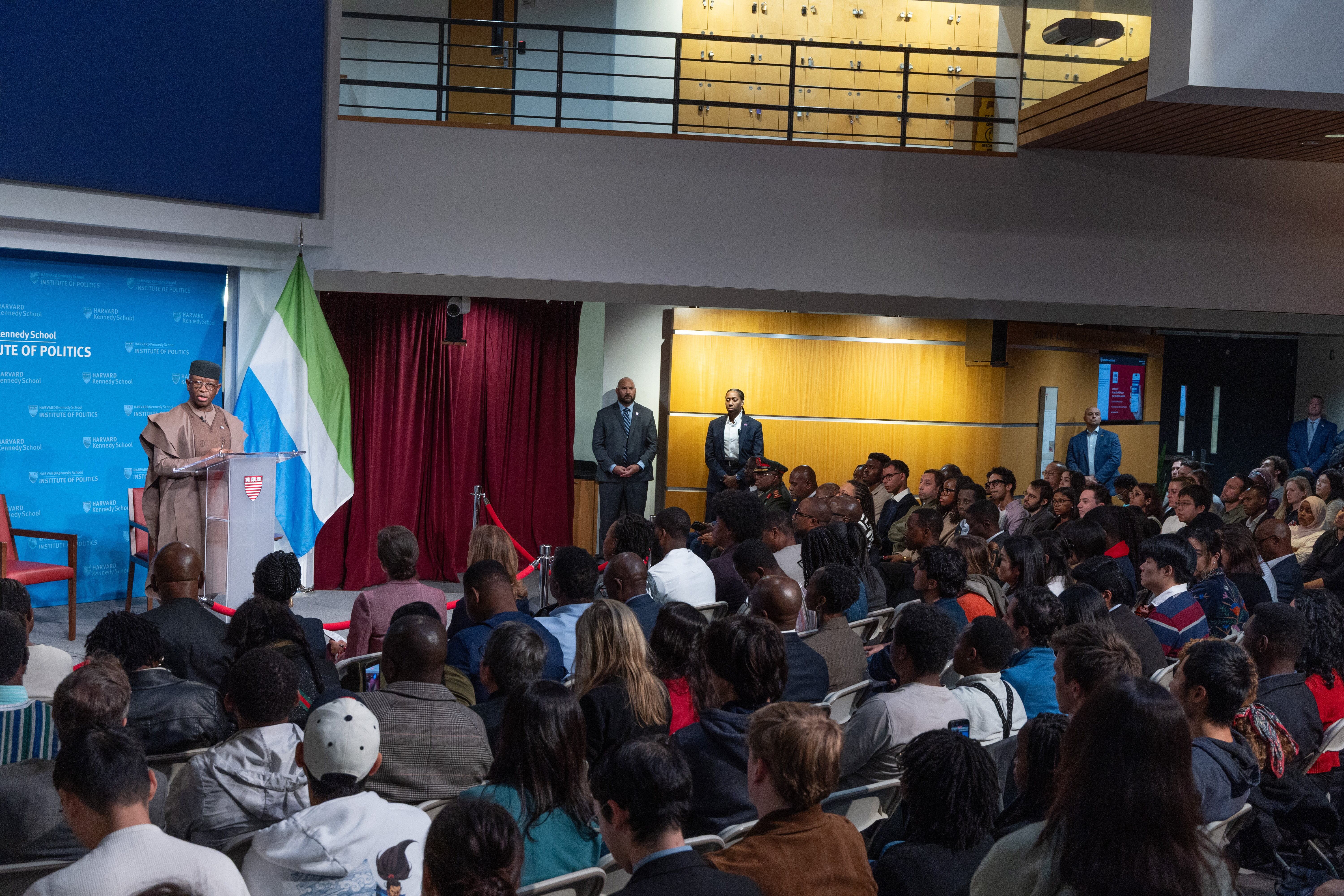
Cambridge - On October 29, the Harvard University Center for African Studies, with the Institute of Politics and the Center for International Development, welcomed His Excellency Julius Maada Bio, President of the Republic of Sierra Leone, to the John F. Kennedy Jr. Forum. Dr. Zoe Marks, Oppenheimer Faculty Director of the Center and a scholar of Sierra Leone’s civil war, moderated. The visit came seven years after the President's first Forum appearance in 2019, when he called for a “Sierra Leonean Renaissance”. In the intervening years, the President was not only re-elected for a second term, but West African country has been buffeted by the Covid pandemic, successive price shocks, popular protest, and a rupture in the predictability of Western partnerships. These challenges gave the evening’s themes of leadership, democratic resilience, and strategic choice considerable weight.
“For too long the world has asked what should be done about Africa,” argued President Bio. The more pressing question is what Africans will do with their growing demographic, economic, and diplomatic weight. “Attention is not influence,” he observed: summits and delegations do not automatically translate into development deliverables, nor turn natural resources or a youthful population into broad-based prosperity. He spoke candidly of how, in 1996, as a young military head of state in a country wracked by civil war, he proceeded with democratic elections against the advice of those who counselled delay. And he pledged in his speech that in 2028 he would “hand over power again – as a democrat.”
His commitment carries particular significance in West Africa today, where term-limit manipulation and military coups have become more common and disrupted the ECOWAS regional commitment to constitutional rule. President Bio’s vocal support for democracy also sits alongside his recent rapprochement with former President Ernest Bai Koroma, and attempts to navigate demands within his party that he extend his term. Electoral authority is necessary but insufficient for ethical leadership, he argued, stating that public trust must continue to be earned after the votes are counted.
Given his unique position as a democratically elected leader who had previously served a short transitional military term, Marks asked how he had handled the withdrawal of Mali, Burkina Faso, and Niger from ECOWAS. Drawing on his time as Chairman of the regional bloc, President Bio described the departures as signaling a “serious loss of confidence”. He conceded that ECOWAS may not have fully served them, but also insisted that Russia was not a reliable or durable alternative security partner. His emphasis on shared borders and the spillover effects of challenges, like armed conflict and climate vulnerability, requires a difficult balance between defending constitutional order and creating pathways for engagement with military governments.

At the global level, Marks asked the President to trace how seemingly distant geopolitical events reach markets and households in Sierra Leone, a country that imports much of its food and fuel while supplying roughly a fifth of the world’s rutile. His answer pointed to how exposed small economies are to shocks they do not cause. He described how inflation rose from about 18 to 55 percent after the war in Ukraine. And, after extensive efforts by his administration to get inflation back under control, he witnessed all the progress made being again reversed by turmoil in the Middle East. Asked about his efforts to push for UN Security Council reform, where he coordinates the African Union’s Committee of Ten, he noted that the permanent members now acknowledge the African common position – demanding a permanent seat – even as “the gatekeepers are still holding the gate.”
As official development assistance declines markedly in the US and elsewhere, President Bio asserted that Africa will not align with East or West, but “will be pro-Africa”. He laid out his four criteria for judging partnerships: do they build skills, create local jobs, support industrialization, and strengthen autonomous decision-making? He also pointed to an asymmetry in U.S.-Africa relations, in which access to critical minerals is pursued while restrictions on travel and study narrow the human exchange that has historically sustained those ties.
Audience questions on vaccine manufacturing, market integration, AI, and value addition kept returning to implementation. The President’s account of free education was instructive: removing fees soon required paying for examinations, school feeding, transport, and textbooks, now financed with more than a fifth of the national budget. In closing, Marks returned to the evening’s central phrase. Taken together, the conversation suggested that Africa’s influence in a shifting order may depend less on how much external interest the continent attracts than on whether domestic institutions and continental coordination can turn that interest into durable bargaining power.