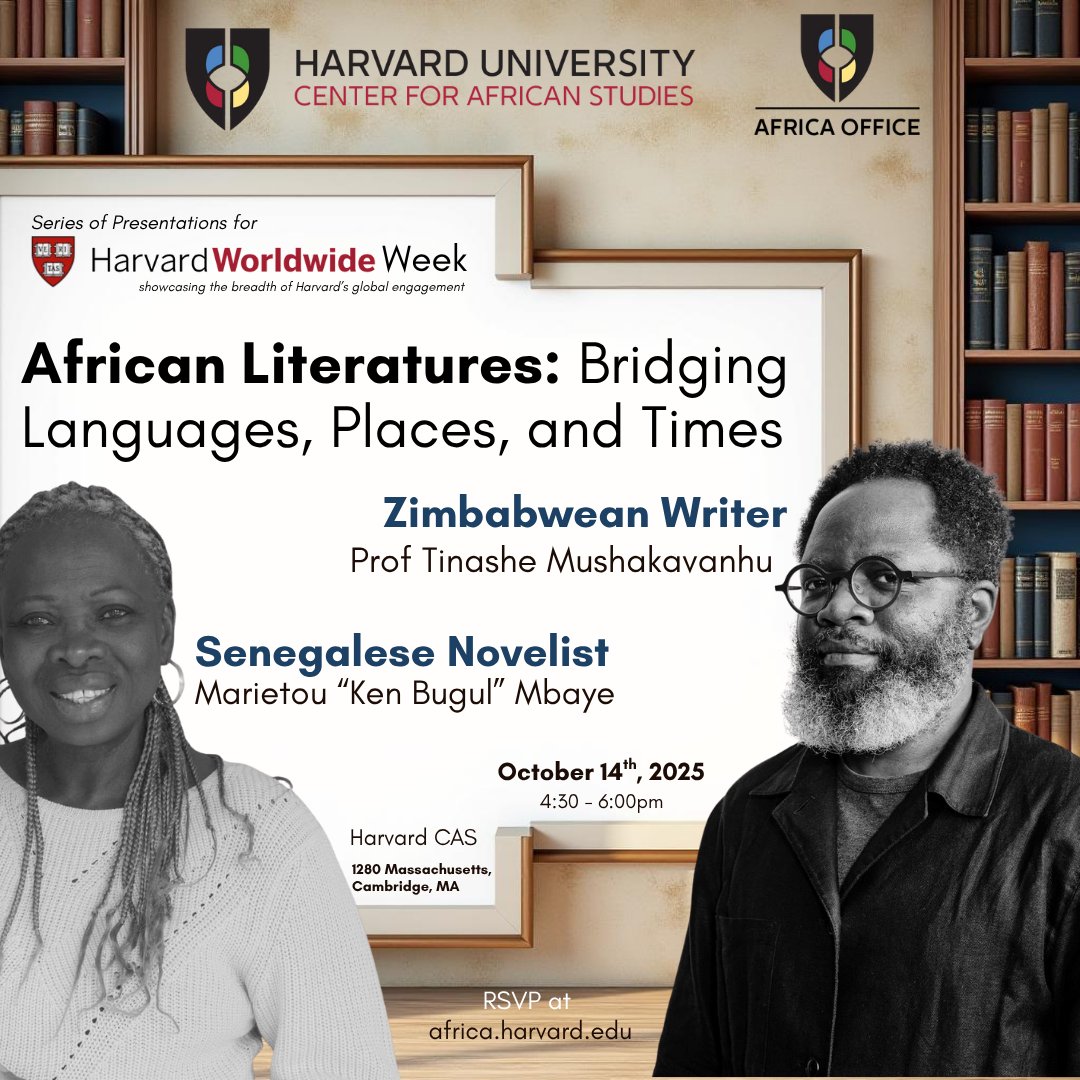
Panel: African Literatures - Bridging Languages, Places, and Times

Date and Time
Location
As part of Harvard Worldwide Week, join us for a Literature Panel "African Literatures: Bridging Languages, Places, and Times" on Tuesday, October 14, 2025, 4:30-6:00pm. Join us for a discussion that explores the power of storytelling across cultures, histories, and generations.; with Zimbabwean Writer - Professor Tinashe Mushakavanhu and Senegalese Novelist - Marietou "Ken Bugul" Mbaye
This event is part of Harvard Worldwide Week, showcasing the depth and breadth of Harvard’s global engagement. During Worldwide Week, Harvard Schools, research centers, departments, and student organizations host academic and cultural events with global or international themes.
While we encourage our Cambridge/Boston residents to join us in-person at the Harvard Center for African Studies, we are providing a virtual option for those outside of the area. Join using the link below:
https://harvard.zoom.us/j/93740034620
Panelists:

Marietou Mbaye chose to adopt the pen name Ken Bugul, which means the one nobody wants, in Wolof. She is an internationally acclaimed Senegalese novelist with 11 novels. Le Baobab fou (1982) -in English, The Abandoned Baobab (University of Virginia Press, 2008) - marked her entry into World literature. The novel has been translated into several languages and has been characterized as a feminist manifesto. It is a canonical text in Francophone African Literature. Ken Bugul’s novels are introspective and center around questions of gender, sexuality, madness, African spiritualities, indigenous approaches to healing, ecology and urban development, race, and migration. Ken Bugul is also a renown feminist activist and a fierce advocate for peace. Prior to devoting herself entirely to her literary career in 1993, she worked for the International Planned Parenthood Federation in Kenya, Togo and Congo. She is the recipient of many prestigious awards, including the Grand Prix Littéraire Afrique Noire for her novel Riwan ou le chemin de sable(1999) and most recently a Dr. Honoris Causa from the University of La Laguna, Tenerife, Canary Island in Spain. Ken Bugul is an officer of the French Order of Arts and Letters.. In addition to her many novels, Bugul has published influential articles on colonialism and African women’s writing. She loves to cook and visit places of worship.
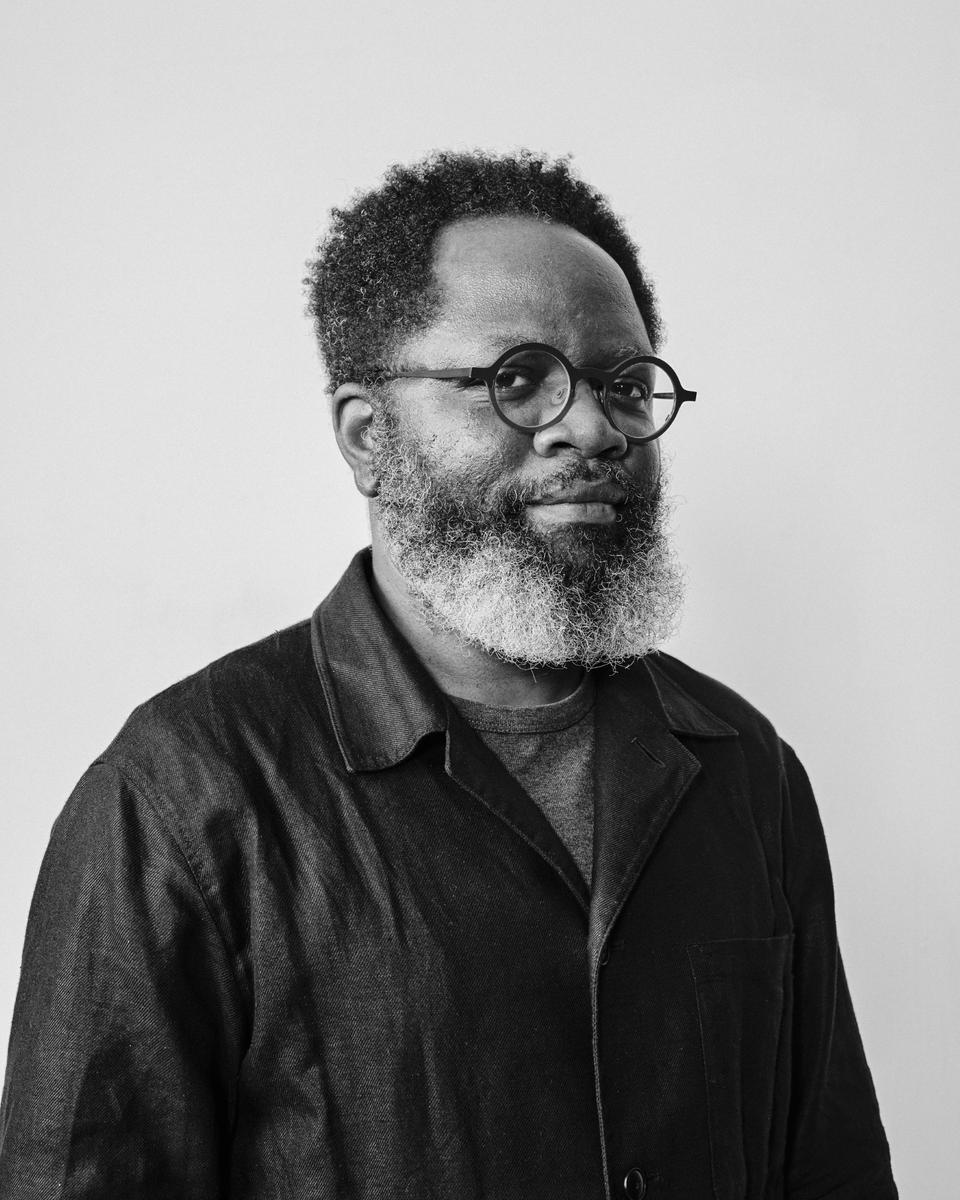
Dr. Tinashe Mushakavanhu is a tenure-track Assistant Professor in African and African American Studies at Harvard University. Previously, he was a Junior Research Fellow in African and Comparative Literature at the University of Oxford. He holds a PhD in English from the University of Kent and an MA in Creative Writing from Trinity College, Carmarthen.
At the heart of Mushakavanhu’s research is a commitment to rethinking African literature through the archive, not only as a repository of memory, but as a method of critique and creativity. He engages with the dispersed, often overlooked materials of African writers to chart new narratives about literature’s role in shaping political and cultural imaginaries. His work moves across genres and media - books, exhibitions, film - foregrounding questions of craft, process, and method. Whether exploring Pan-African literary networks, the aesthetics of stone sculpture, or the infrastructures that support African knowledge production, Mushakavanhu’s research reveals literature as both an intellectual practice and a public, political act.
His acclaimed book Some Writers Can Give You Two Heartbeats (2019) exemplifies this method. Conceived as a triptych - a publication, a film, and a travelling exhibition, the book embodies an immersive, experimental approach that brings archival research into conversation with creative practice. Mushakavanhu’s current and forthcoming projects continue to explore this terrain, seeking to expand the possibilities of how African literary and cultural histories are told, experienced, and understood.
Beyond academia, Mushakavanhu’s work is shaped by a longstanding engagement with publishing and journalism. These experiences inform his interdisciplinary approach to research and teaching, grounded in a commitment to interrogating the politics of knowledge production and its implications for Africa and its global diasporas. His work often takes the form of ambitious, intercontinental collaborations that build networks and infrastructures of thought.