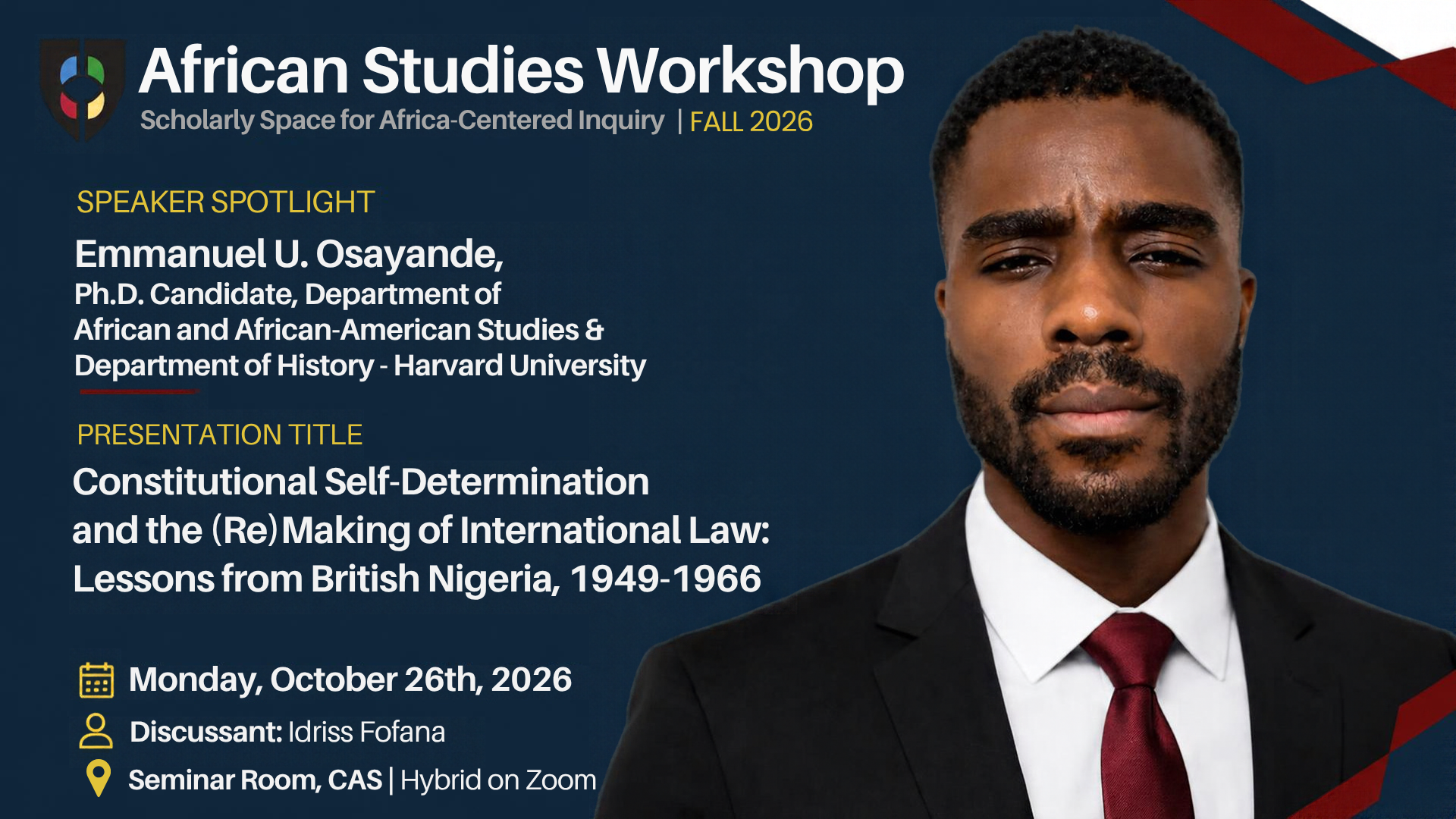
ASW - “Constitutional Self-Determination and the (Re)Making of International Law: Lessons from British Nigeria, 1949–1966” with Emmanuel Oyasande

Date and Time
Join us for an African Studies Workshop with Emmanuel U. Osayande, Ph.D. Candidate in African and African American Studies/History at Harvard University, with Idriss Fofana serving as discussant.
Osayande’s paper examines the period between the 1949 Enugu shootings and Nigeria’s first military coup in 1966 to argue that Nigerian anticolonialists and early independence leaders pursued a project of constitutional self-determination. Their goal was not only political independence, but also the consolidation of Nigeria’s international standing through the domestication and institutionalization of postwar international legal norms.
Rather than treating international human rights as a one-way imposition on Nigerian sovereignty or as a late addition to constitutional debates, the paper argues that Nigeria’s constitution-making process was itself a practice of international law. It traces this argument across three connected areas: the postwar international legal framework, including the UN Charter, the Universal Declaration of Human Rights, and the European Convention on Human Rights; Nigerian constitutional conferences and debates over federalism, minorities, religion, public order, and self-determination; and the legal diplomacy and organizational practices of the early 1960s that internationalized domestic norms.
The paper concludes with the political and legal shifts of 1966, considering what Nigeria’s experience reveals about both the possibilities and limits of international law and human rights.
About the Speaker
Emmanuel U. Osayande is a Ph.D. candidate in African studies and history at Harvard University. His dissertation, Rulers and Rebels: International Law, Human Rights Strategy, and Governance in Urban Nigeria, 1949–1999, is a post-World War II socio-legal history examining how historical actors within and beyond urban Nigeria engaged international law and human rights in relation to governance, constitutional politics, international order-building, authoritarianism, rights activism, climate change, and policing.
Osayande earned a J.D. with honors from Columbia Law School, an A.M. in African Studies from Harvard University, an M.A. in History from the University of North Carolina at Chapel Hill, and a B.A. in History and Strategic Studies with first-class honors from the University of Lagos. His scholarship has appeared in African Research Review, the Canadian Journal of African Studies, Just Security, and Opinio Juris, among other outlets. His research has been supported by the Mellon Foundation, the Weatherhead Center for International Affairs, and the Harvard Center for African Studies.