

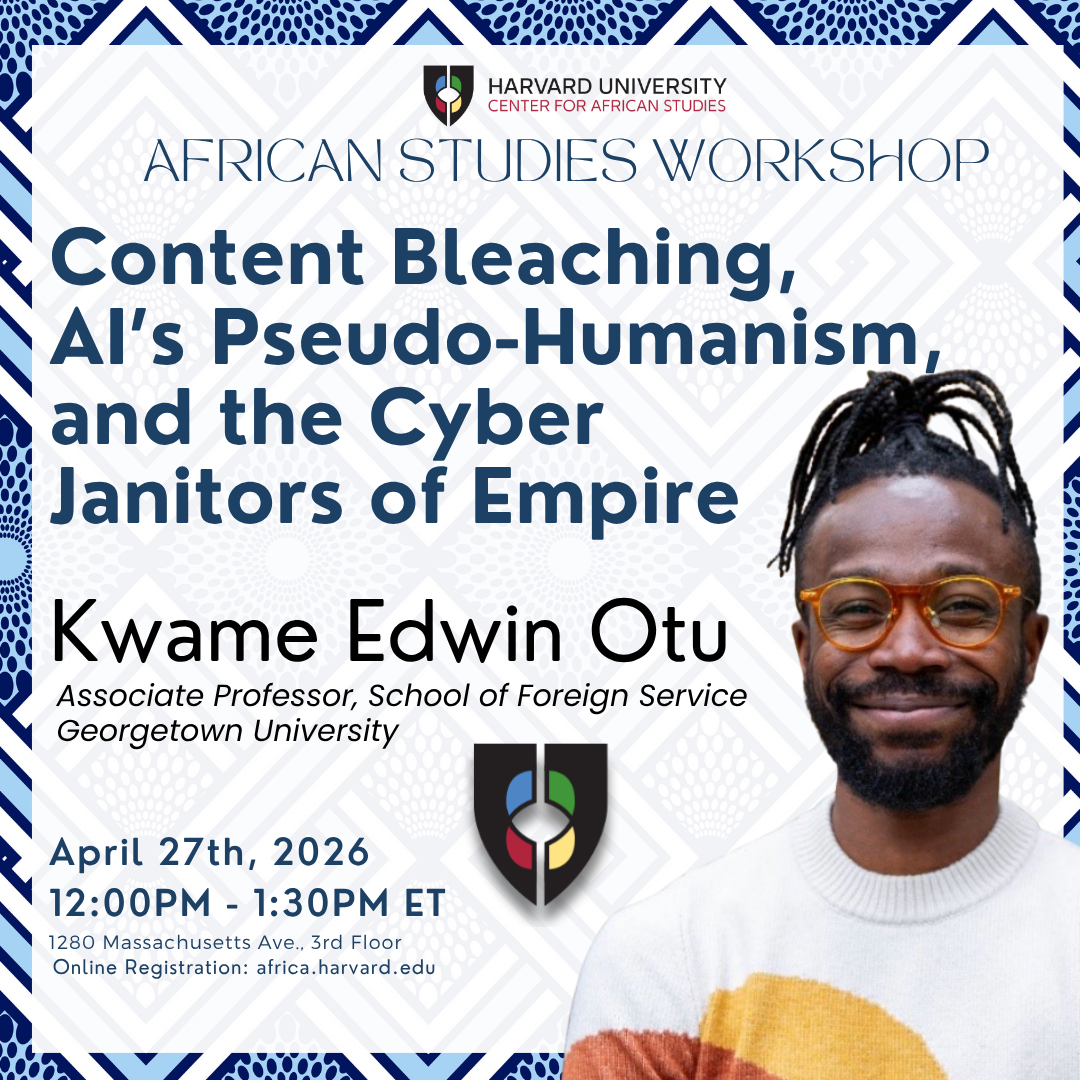
ASW - “Content Bleaching, AI’s Pseudo-humanism, and the Cyber Janitors of Empire ” with Prof. Kwame Edwin Otu

Date and Time
Location
Join us for our in-person African Studies Workshop! The workshop series is a scholarly space for Africa-centered research, offering a diverse range of topics and scholarly backgrounds to explore historical and current conditions.
APRIL 20, 2026
Speaker: Kwame Edwin Otu, Associate Professor in the African Studies Program, Edmund Walsh School of Foreign Service at Georgetown University. Discussant: Professor Daniel Agbiboa, Associate Professor of African and African American Studies, Harvard University.
Title: Content Bleaching, AI’s Pseudo-humanism, and the Cyber Janitors of Empire
Bio: Kwame Edwin Otu is an Associate Professor in the African Studies Program at the Edmund Walsh School of Foreign Service at Georgetown University. Otu is a cultural anthropologist with interests ranging from the politics of sexual, environmental, and technological citizenships, public health, to their intersections with shifting racial formations in neocolonial and neoliberal Africa and the African Diaspora. Otu’s first book monograph, Amphibious Subjects: Sasso and the Contested Politics of Queer Self-Making in Neoliberal Ghana, is part of the New Sexual Worlds Series edited by Marlon Bailey and Jeffrey McCune, and is published by the University of California Press. The book is an ethnography on queer self-fashioning among a community of self-identified effeminate men, known in local parlance as sasso. In the monograph, he draws on African philosophy, African/Black feminisms, and African and African Diasporic literature to explore how sasso navigate homophobia and the increased visibility of LGBT human rights politics in neoliberal Ghana. Otu’s current/ongoing project investigates the global politics of e-waste in particular, and the undulations of global environmental transitions in general, and their impacts on African and African-descended bodies. Entitled The Salvage Slot: Technology and the Ecologies of the After-Afterlife in Necropolitcal Ghana it is an ethnography on waste workers on
Abstract: A 2023 Time magazine publication reported that Kenyan content moderators working in a Silicon Valley based company called Sama, outsourced by Open AI, experienced depressive episodes from filtering toxic content from themes fed into ChatGPT. According to the report, the “data cleaners” earned between $1.32 to $2 per hour “depending on seniority and performance.” This kind of labor performed by African workers to clean up toxic content used to train large language models like OpenAI’s ChatGPT embodies “content bleaching.” The Kenyan exposé on the toxic consequences of digital labor parallels the experiences of e-waste workers in Agbogbloshie, Ghana. Whether it is in decontaminating software or laundering hardware, these bodies reveal Africa’s paradoxical location as a source of labor extraction and a sink for moral and psychological deposition. I take “bleaching” in its literal and metaphorical terms to examine how content bleaching is both a byproduct of and produces anti-Blackness. Like the corrosive skin bleaching practices pervasive in Africa and the African diaspora, where Black skin is bleached because it signifies dirt, ugliness, darkness and other, the dirty work undertaken by Black bodies entrenches a particular idea of the human. Thus, as janitors of the cyber world, data cleaners and e-waste workers unmask AI’s pseudo-humanism, like OpenAI’s claim to create an AI that “opens” the playing field to all humans. In this project, I ask a twofold question: What are the entanglements between skin bleaching and content bleaching? How do these entanglements reveal the “overrepresentation,” to use Sylvia Wynter’s terminology, of a particular way of being human?
Discussant: Daniel Agbiboa ( Associate Professor, Harvard University)
If you are in Cambridge/Boston, we encourage you to join us in the Seminar Room at the Harvard Center for African Studies. If you are joining us virtually, please register here on Zoom. Once you register, you will receive the Zoom Link in your email inbox.
For future workshops, please join our ASW mailing list. All speakers are listed below.


